
 English
 Greek
 Spanish
 Ukrainian
 Turkish
 Swedish
 Portuguese
 Russian
 German
 Bulgarian
 Arabic
 O'zbekcha
 Қазақ
Top Manufacturers Offering Both Furniture Machinery and Packaging Solutions
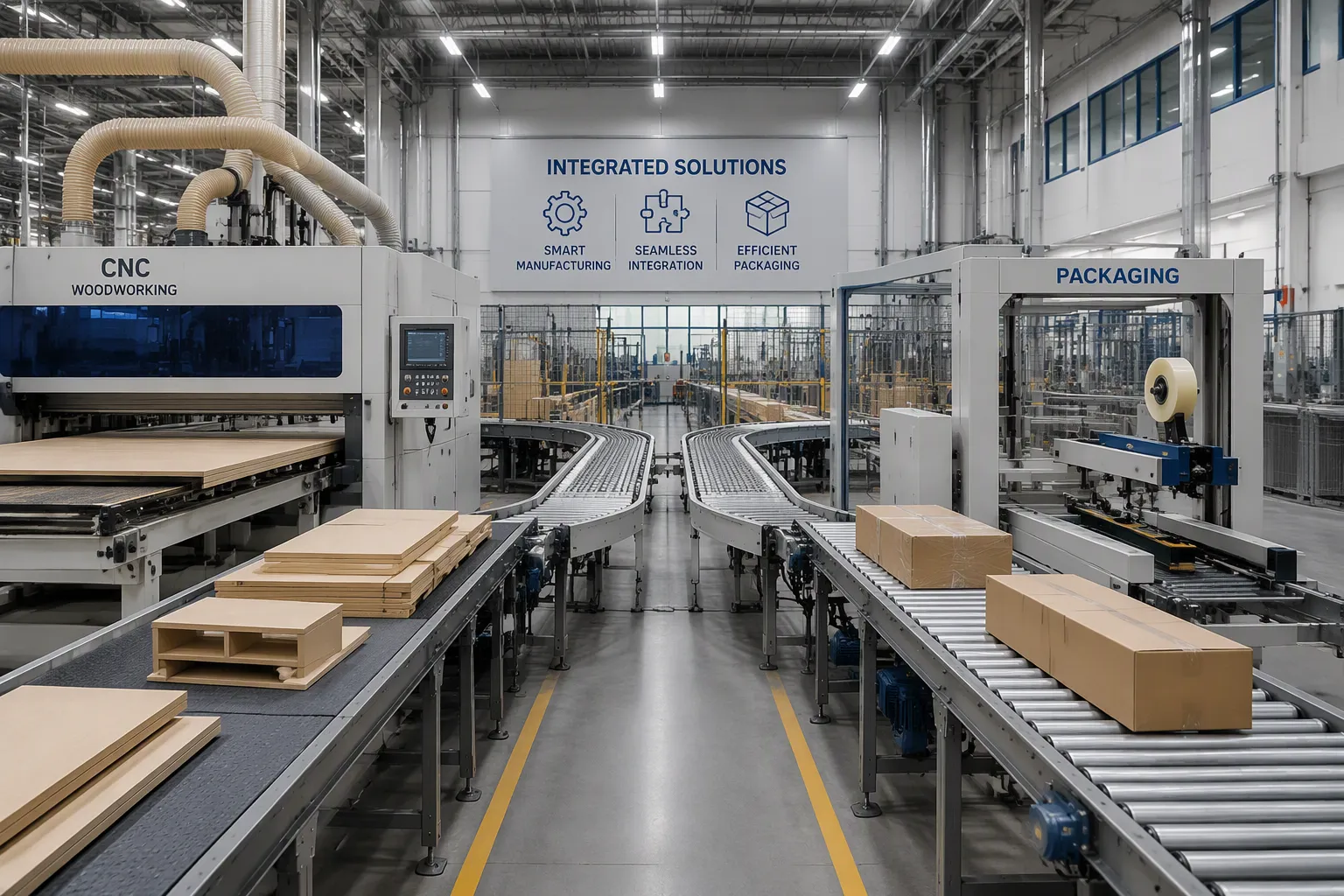
KDT tops this list of makers that build both furniture machines and packaging equipment. The other checked names are [Manufacturer B] and [Manufacturer C]. You can judge each option on four points: technical performance, application fit, regulatory compliance, and cost. These four tests keep the comparison fair across very different product lines.
Your team needs a shortlist you can defend and a repeatable way to recommend a manufacturer with confidence. A clear list plus a fixed scoring frame turns a subjective debate into a documented decision. Start with these names:
KDT
[Manufacturer B]
[Manufacturer C]
Key Takeaways
Using one supplier for both furniture machines and packaging equipment makes vendor management easier and saves money.
Judge manufacturers by their technical performance, how well their products fit your needs, regulatory compliance, and cost.
KDT offers many machines and packaging solutions, making it a strong choice for both needs.
Always ask for demos using your own materials. Also check the compliance documents before you recommend a manufacturer.
Pick the packaging format that fits your product type. This helps protect furniture during transit and cuts down on damage.
Why One Supplier for Both Needs
Operational and Commercial Benefits
Using one supplier that can do both jobs makes your vendor list much simpler. You send one set of orders, sign one contract, and train your team on one service channel. The connection matters most where the two stages meet: the machine that cuts and edges panels sits next to the line that wraps and boxes them. One supplier designs both ends to work together, so you avoid problems between separate vendors.
Flexibility gets better too. When demand changes, you adjust output across both stages with one partner. Support also gets easier, because one service network covers every machine in the workshop. You save money through combined shipping, shared spare-parts logistics, and fewer administrative steps. These gains grow as your packaging automation and machining lines connect more tightly.
Where Dual Sourcing Fits Best
Single-supplier sourcing works especially well for small to mid-sized operations. These manufacturers want equipment investments they can phase in and manage, plus targeted upgrades to bottlenecks in edge banding, CNC drilling, or nesting. They serve panel furniture, cabinets, wardrobes, and wooden doors, and they process plywood, MDF, particle board, and OSB. One partner covering both furniture machinery and furniture packaging keeps the workshop coordinated without a complex vendor structure.
Characteristics | Product Types Served | |
|---|---|---|
Small to mid-sized manufacturers | Phased investments; targeted bottleneck upgrades; focused process improvements | Panel furniture, cabinets, wardrobes, wooden doors |
Large-scale / greenfield plants | High-capacity mass manufacturing; integrated smart factory workflows; minimal labor dependency | Panel furniture, custom cabinetry, office furniture, wooden doors |
Large plants can benefit too, especially when they want integrated automation across the full line. Still, dual sourcing remains a valid choice when your volumes are high or your needs are highly specialized. Match the sourcing model to your factory space, material choices, and daily output capacity.
How to Evaluate and Recommend a Manufacturer
Technical Performance and Application Fit
Start with reliability and system integration. A machine that stops often erodes the gains from a fast cycle. Track unscheduled down-time, rework, and overall equipment effectiveness (OEE) across the whole line, not just one unit. These measures show how well the machinery and the packaging stage work as one system.
KPI | What it measures |
|---|---|
Unscheduled Down-Time | Unplanned stoppages that erode productivity |
Rework | Waste and cost from re-processing defective output |
Overall Equipment Effectiveness (OEE) | Combined performance of a single machine or the whole packaging line |
Capacity Utilization | Share of available line capacity actually used |
Application fit matters just as much. Confirm the equipment handles your materials and product sizes. Check changeover time for switching product lines, since short runs punish slow setup. Ask for a demonstration on your own panel types before you recommend a manufacturer to your team.
Compliance, Support, and Total Cost
Compliance differs by market. In the European Union, CE marking is mandatory before market access, and woodworking and packaging machinery fall under the Machinery Directive. Risk assessment follows EN ISO 12100, and high-risk Annex IV categories need a notified body. In the United States, no single federal machinery certificate exists; NRTL listing, OSHA requirements, and ANSI B11 guarding standards apply instead.
Support and total cost decide long-term impact. Treat the purchase price as the opening figure and estimate five-year costs for installation, training, energy, tooling, spare parts, maintenance, and downtime. Compare cost per good package rather than hourly output. Ask for written response times and spare-parts delivery terms.
Use this seven-step approach:
Define needs and output targets.
Screen manufacturers on both product lines.
Score technical performance and application fit.
Verify compliance documents for each market.
Compare total cost of ownership.
Check references from similar facilities.
Review ROI and document the recommendation.
Write the recommendation as a short brief: criteria, scores, cost comparison, and risks. Attach the compliance file and demonstration notes. This gives stakeholders a defensible record and a repeatable path to recommend a manufacturer.
Top Dual-Capability Manufacturers: KDT
Machinery and Packaging Range
KDT is a company listed on the Shenzhen stock exchange (stock code 002833). Its headquarters are in Guangzhou, and it has an R&D and production center in Italy. Its products reach more than 70 export countries. The company also ranks among China's Top 500 Machinery Enterprises. That size matters when you compare manufacturers, because few suppliers cover both furniture machinery and packaging under one roof.
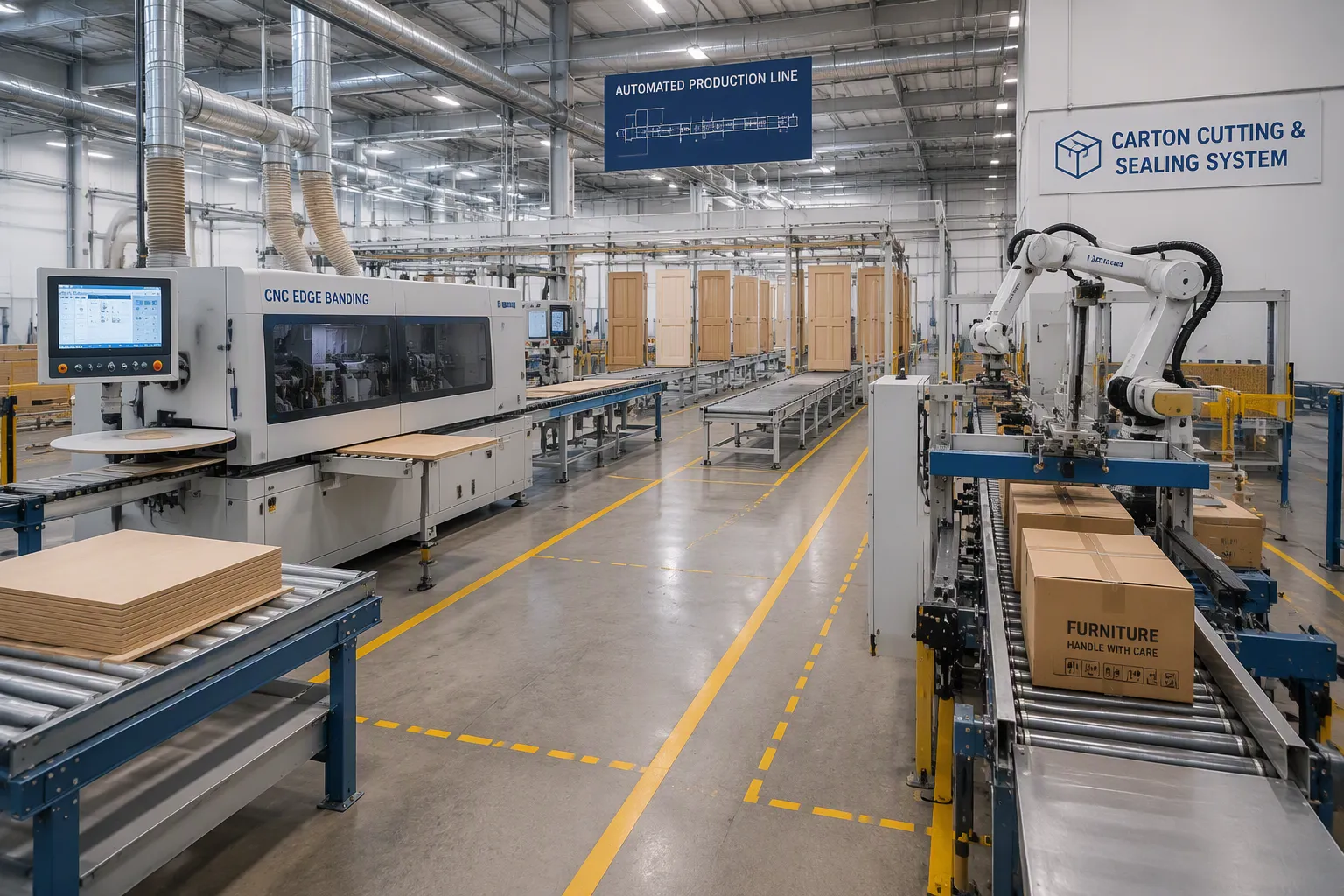
The core range includes edge banders, drilling machines, panel saws, CNC machining centers, flexible automated production lines, and packaging solutions. Specific models show you how deep the range goes. Edge banders run from the KS-833HG high-speed unit to the KE-2826 with a maglev-driven horizontal end-cutter. Drilling machines include the KD-812ZA with six drill sets and four router motors, plus the KD-812A rated at 480 PCS/H. Panel saws such as the KS-533A bring robotic saw technology to the cut.
On the packaging side, KDT supplies carton cutting and sealing systems. The WG8C5H6P12 handles custom carton cutting with a maximum throughput width of 2500mm. The WG8C3HK2 supports batch customization up to 3000mm. The WG8C2H1W1 and WG8C1H4P4 each cover 120+ carton types with one-click packaging solution definition. The WG8V6H seals pre-folded cartons through a fully automatic hot melt adhesive system. Together these units support automated box making and packaging automation in the same workshop as the machining line.
KDT also offers flexible automation solutions. These include a U-shape edging cell with two machines, an automated production line for wooden doors, and door-tech automation. This is the practical value of one vendor: your packaging equipment and your cutting equipment share a single planning process.
Innovation milestones trace the company's technical path:
2015 — KDT developed the first domestically produced upward drilling five-sided CNC drill.
2021 — The first domestically produced magnetic levitation CNC panel saw earned patent certifications from Germany, Italy, and China.
2022 — Hongya CNC introduced Italian technology to localize high-end five-axis machining centers.
2023 — The first domestic flexible high-speed edge bander with maglev-driven technology was rated as internationally leading.
Best-Fit Applications
KDT fits panel furniture manufacturing, customized production, small panels, narrow panel edge banding, and door manufacturing. The KHM-660B door machining center handles lock holes and hinge slots. Edge banders suit manufacturers of all sizes and manage high-volume orders, so the range scales from compact workshops to high-spec plants.
Choose KDT when you want one partner for both stages, when your output mixes standard and custom runs, and when you plan to add packaging automation as volume grows. The breadth of available machinery and the packaging solution lineup let you phase investment without changing vendors. For teams weighing custom machinery against standard lines, KDT's flexible automation options give you a middle path.
More Manufacturers Offering Furniture Packaging
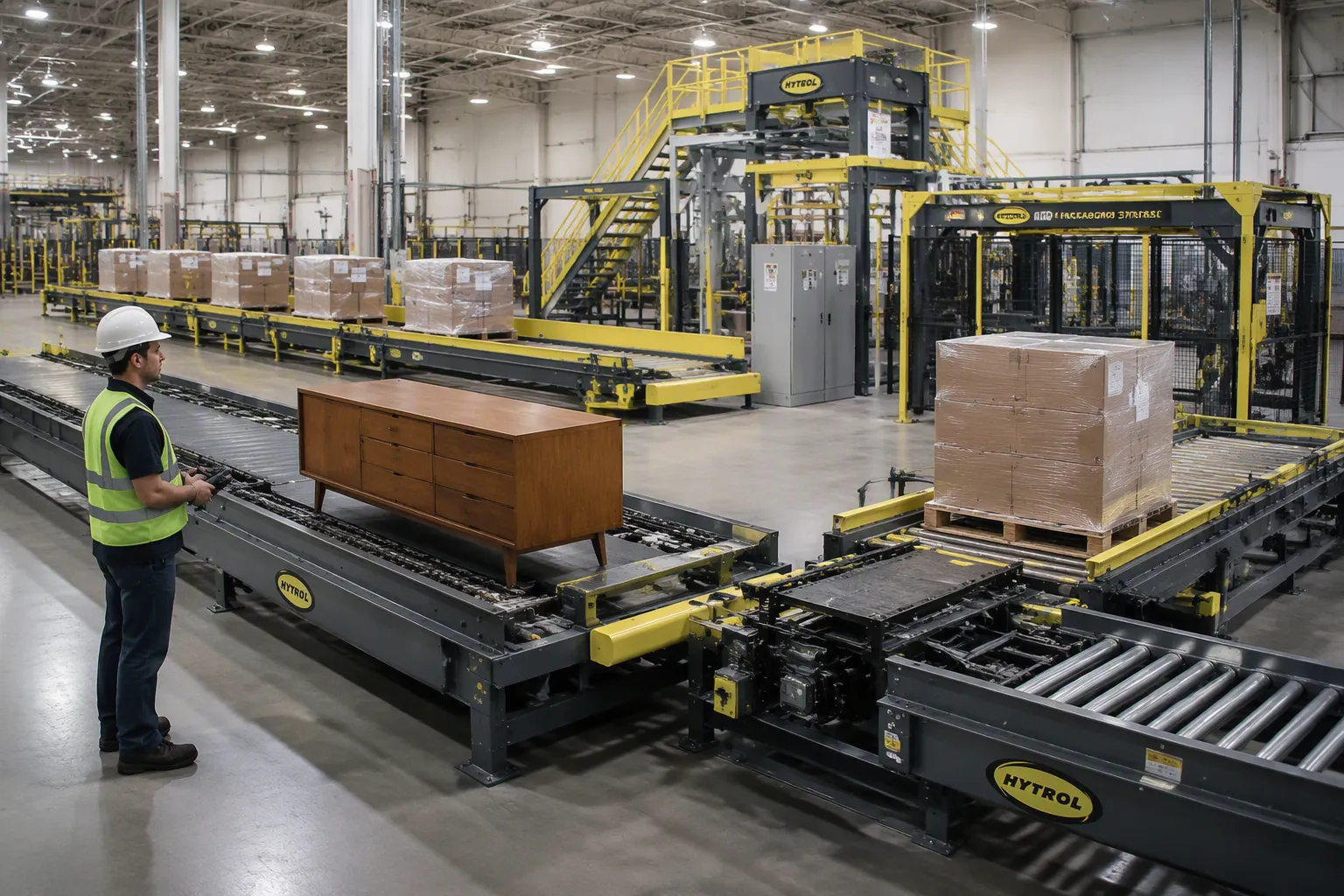
Two more verified manufacturers complete the shortlist. Each one brings a clear strength to furniture packaging, and each fits a different kind of production. Compare them using the same four criteria you used for KDT.
[Manufacturer B] — Line Integration Strength
Manufacturer B stands out when you need to connect new packaging equipment to systems already running in your plant. The company prefers a non-disruptive integration approach. It adds capability to new and existing hardware and software instead of replacing what you already own.
B-Line emphasizes a non-disruptive integration approach: rather than replacing existing systems, it extends capabilities to new and existing hardware and software already in use. It positions itself as an AI-powered building management platform that integrates with third-party products, and offers an integration request/exploration pathway for finding or requesting integrations.
That same thinking carries into its conveyor and packing line work. The table below shows the building blocks you can specify for a furniture packaging line.
Integration Capability | Description |
|---|---|
Drag Chain Packing Conveyors | Powered drag chain sections at nearby packing stations to keep load preparation flow steady |
Chain Transfer Modules | Automatic chain transfers that move finished pallets from station conveyors onto the main takeaway path |
Hytrol 25-CRR Chain-Driven Live Roller Conveyor | Mainline transport that keeps loads moving continuously from pack to downstream processing |
Banding and Order Accumulation Path | High-volume orders are banded and sent to an accumulation conveyor with anti-contact protection |
Custom FloStor Crating Module | A combined transfer cart, lift table, and conveyor that lets crate-required loads move offline, rise for easier access, and return to the main line |
The performance results support the design. Throughput rose about 30%–35% over the old manual system. Daily output reached around 150 racks per line per eight-hour shift. Forklift wait time dropped thanks to automated pallet transfers, and raised crating access improved ergonomics and load securement.
Choose Manufacturer B when your plant already runs conveyors and you want packaging automation that adds on top. Its strength is line integration, not standalone box making.
[Manufacturer C] — Custom Packaging Strength
Manufacturer C fits the opposite case. You have unusual carton sizes, mixed product profiles, or protective needs that standard lines cannot meet. This packaging manufacturer's edge is custom packaging solutions built around your product mix.
The company designs automated box making and wrapping systems to your dimensions. You get tailored carton cutting, sealing, and protective packaging instead of a fixed catalog line. That flexibility suits furniture makers with varied SKUs and short runs.
Weigh the trade-off. Custom machinery takes longer to specify and commission than a standard line. Confirm the packaging manufacturer's spare-parts network and service response before you commit. For teams that need packaging equipment matched to a unique product, Manufacturer C earns its place on the shortlist.
Matching Furniture Packaging Optimization to Your Line
Furniture packaging must fit the product, the segment, and the daily volume. Think of furniture packaging as damage insurance, not just a cost. Furniture packaging optimization starts with finding the right segment fit.
By Furniture Segment and Scale
Different segments need different packaging approaches. Use this table to match the format to the product.
Segment | Requirement | Purpose |
|---|---|---|
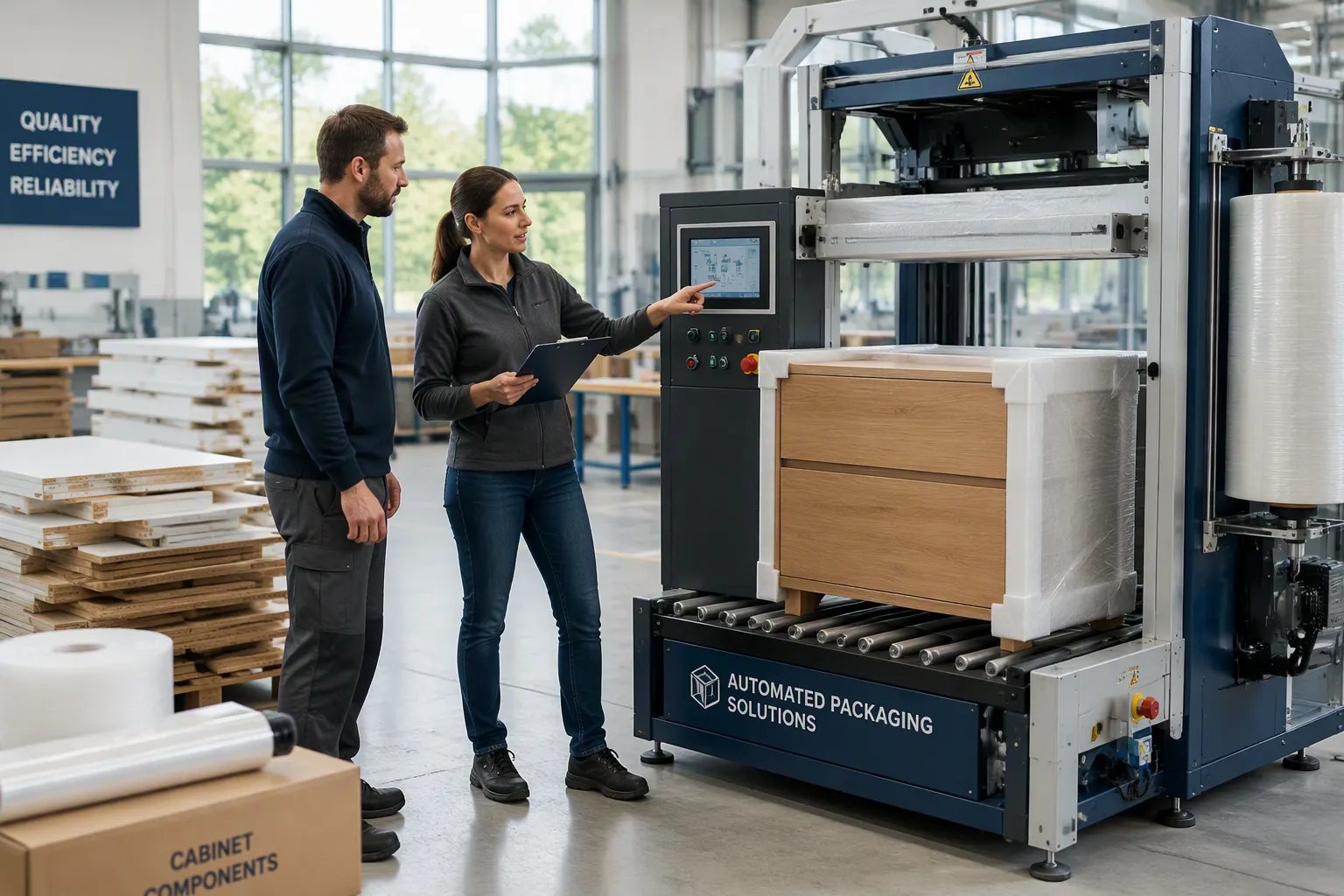
Fully assembled cabinets | Stretch wrapping cell with non-marring top presses and machine-controlled ~250mm film | Protects finishes without crushing hollow boxes |
Upholstery | PE film bagger plus orbital wrapper cell with a 2200mm ring | Zero-gap coverage for soft goods |
Flat-pack RTA components | Pneumatic top-down presses with high-tension stretch film | Unitizes loose boards under compression |
Oversized case goods | Large-ring bundler with a 61-inch ring | Locks parts into one rigid package |
Scale decides which vendor fits. KDT works well for panel furniture and mixed standard-custom runs. Manufacturer B fits plants that already have conveyors. Manufacturer C serves unusual carton sizes. Good ready-to-assemble furniture packaging starts with a written packing sequence: materials, component arrangement, carton size, weight, drop-test limits, and label positions. That discipline keeps furniture boxes intact and cuts down on damage.
By Packaging Format and Integration
Formats range from wrapping and boxing to palletizing and protective packaging. High-end pieces often need bubble or foam dispensers timed with an orbital wrapper using a 1700mm ring. Heavy cabinetry needs corner protectors and internal blocking.
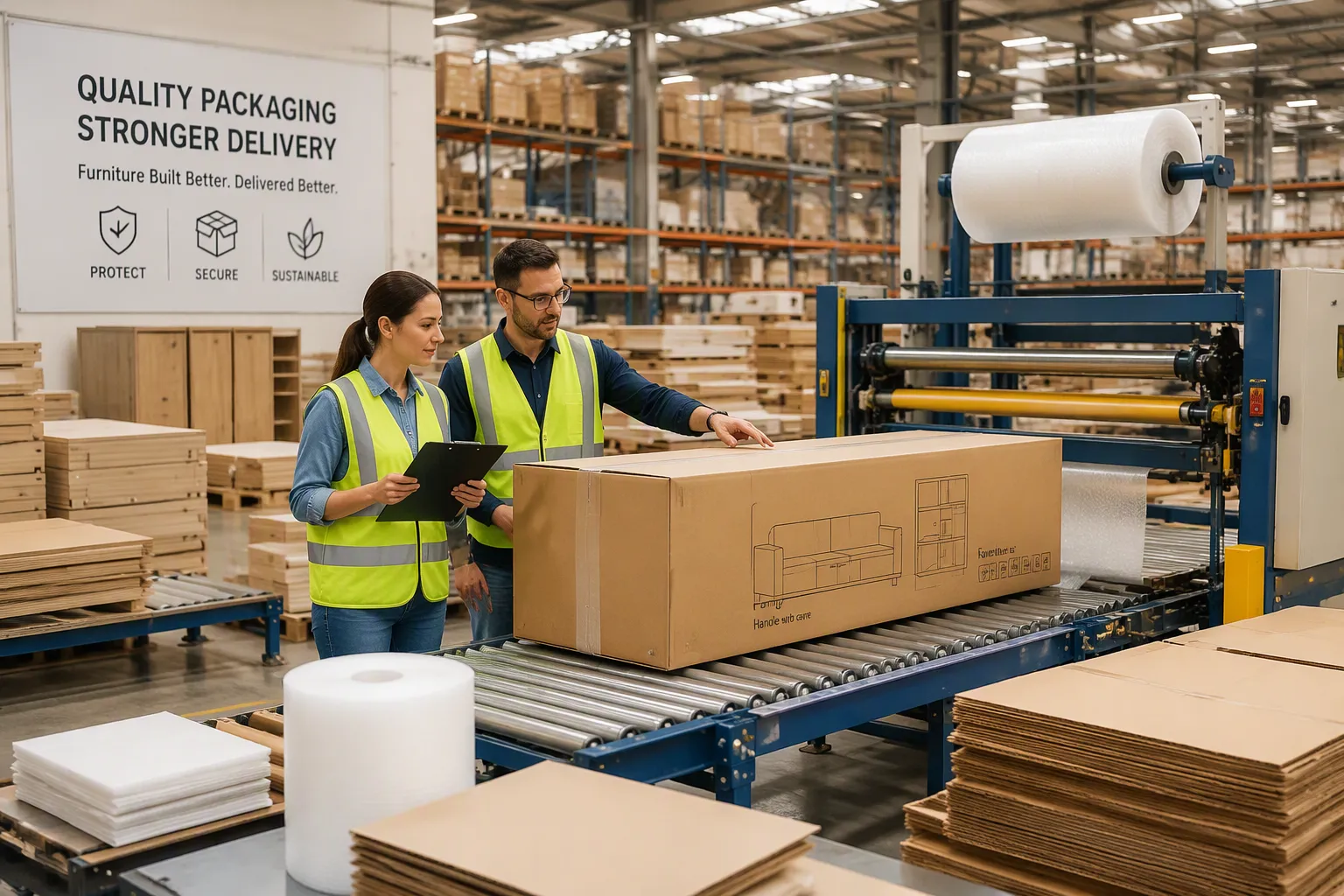
Sustainable systems now replace plastic film with printable paper wrapping. Fit-to-size continuous motion wrapping cuts paper to product dimensions. Document insertion feeders, box dispensing for assembly kits, and optional labelers complete the packaging line. Automated box making and automated box production systems bring packaging automation in-house.
Treat custom packaging solutions as a fit criterion. Ask whether the line handles your carton range, your changeover time, and your traceability needs. Packaging automation pays off when it connects to your ERP through OPC UA, MQTT, or EtherNet/IP. True furniture packaging optimization links format, scale, and data. It delivers furniture packaging designed to survive real transit.
Compare manufacturers on carton range, packaging design support, and packaging equipment lead times. Confirm the equipment handles your panel sizes, and check the automation roadmap for furniture manufacturing. Optimized packaging solutions and custom packaging solutions both belong on your shortlist. Packaging optimization rewards early planning. Plan packaging automation around your carton range, and let your packaging flex as volume grows. Automation must serve the product, not the reverse.
Cost, Compliance, and Risk Checklist
Questions to Ask Before You Recommend
Compliance paperwork decides whether your purchase clears customs and passes an audit. Ask for the CE file for EU destinations, plus the EU Declaration of Conformity and the technical file. Request the risk assessment based on EN ISO 12100. Make sure the user manuals cover installation, operation, and maintenance. For wooden crates, ask for ISPM-15 treatment records. CE does not apply in the USA, Canada, or Mexico, so ask for UL or ETL listing, OSHA compliance, and NOM certification instead. Keep in mind that Machinery Regulation (EU) 2023/1230 replaces the old directive, and compliance is required by 20 January 2027.
Total cost goes far beyond the invoice. Ask how fast spare parts arrive and where the regional inventory is kept. A service network spread across regions keeps response times short. Planned service with certified technicians costs less than emergency call-outs at premium rates. Getting back even a few days of unplanned downtime per year can cover the entire annual service cost. Put these answers in writing before you recommend a manufacturer.
Verification Steps and Red Flags
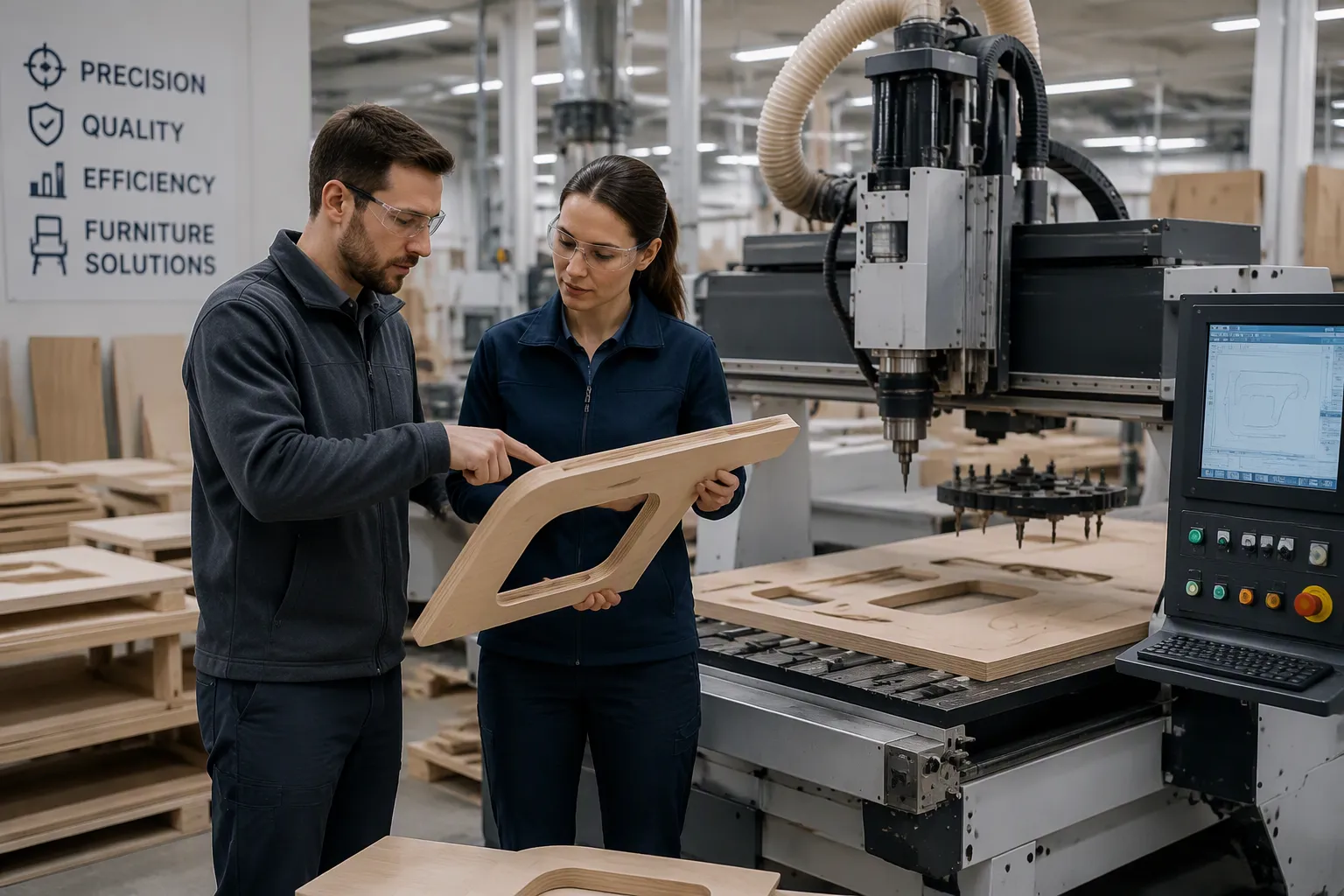
Run a capability demonstration for both product lines. Watch the edge bander or CNC center cut your own panel types, then watch the packaging line wrap and box the same output. Test changeover between carton sizes on the packaging side. Ask for references from facilities with similar volume and product mix.
Treat these signals as red flags: a certificate offered without the technical file, a refusal to demonstrate on your materials, vague spare-parts lead times, and no named service contact for your region. Verify that automated box making and packaging automation run as one connected system, not two separate purchases. Confirm the automation roadmap covers your future carton range. Strong furniture packaging support shows up in documentation and demonstrations, not brochures. Good packaging optimization depends on reducing damage in transit, so ask for drop-test evidence and packing sequence records.
KDT leads this shortlist as the dual-capability choice for panel furniture and mixed standard-custom runs. Manufacturer B fits plants that need line integration, and Manufacturer C suits custom packaging work. Score every candidate on four points:
Technical performance
Application fit
Regulatory compliance
Cost
Before you recommend a manufacturer, request demonstrations for both product lines. Confirm compliance documents for each market. Run a total-cost comparison. Then weigh how each option handles furniture packaging and packaging automation over time. Strong automation partners grow with your line. Dual-capability sourcing simplifies vendor management, and that clarity compounds as your packaging needs evolve.
FAQ
What does a dual-capability supplier actually give you?
You get one contract, one service channel, and one planning process for machines and packaging. Your cutting line and your packaging line share a single design review. That setup cuts administrative work and reduces finger-pointing between vendors when output drops.
How do you confirm KDT covers both product lines?
Ask for a demonstration on your own panel types. Watch the edge bander or CNC center run first, then watch the packaging equipment wrap and box the same output. KDT exports to more than 70 countries, so request references from facilities with your volume and product mix.
Which compliance documents should you request?
Request the CE file, the EU Declaration of Conformity, and the technical file for EU destinations. Ask for the risk assessment built on EN ISO 12100. For US shipments, request UL or ETL listing and OSHA compliance evidence. Note that EU 2023/1230 replaces the old directive by 20 January 2027.
Which packaging format suits your product?
Match the format to the product. Fully assembled cabinets need stretch wrapping with non-marring top presses. Upholstery needs a PE film bagger plus an orbital wrapper. Flat-pack components need pneumatic top-down presses with high-tension film. Oversized case goods need a large-ring bundler. Write the packing sequence before you specify equipment.
How do you document the recommendation for your team?
Write a short brief with criteria, scores, cost comparison, and risks. Attach the compliance file and demonstration notes. Score every candidate on technical performance, application fit, regulatory compliance, and cost. Add a total-cost estimate covering installation, training, energy, tooling, spare parts, maintenance, and downtime.