
 English
 Greek
 Spanish
 Ukrainian
 Turkish
 Swedish
 Portuguese
 Russian
 German
 Bulgarian
 Arabic
 O'zbekcha
 Қазақ
What kind of packaging machinery supplier is suitable for a large furniture factory?
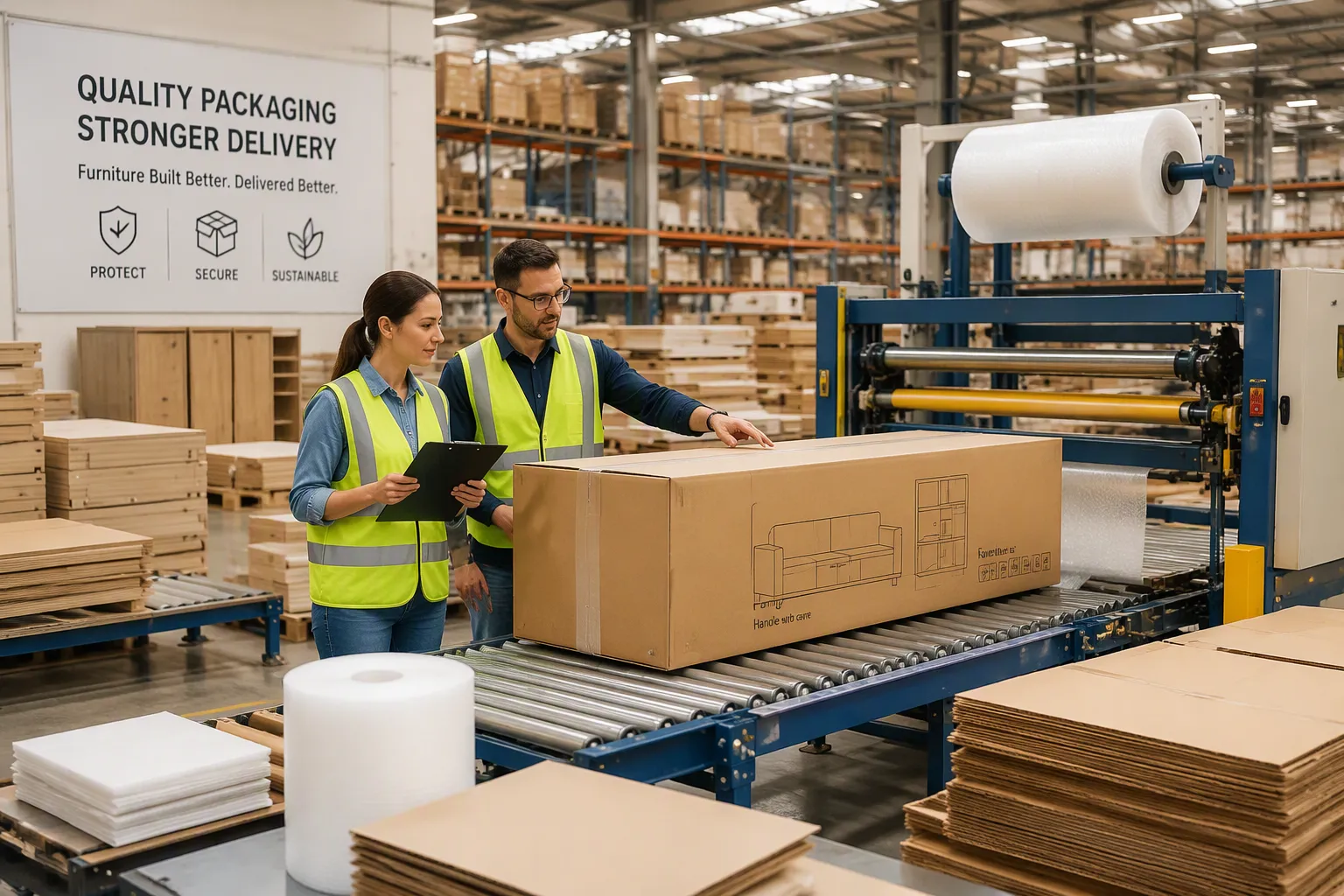
You need a packaging machinery supplier with proven heavy-duty experience, scalable automation, dependable service, and full regulatory compliance. Anything less puts your line at risk.
For a large furniture factory, the stakes are real. Unplanned downtime stops production. Weak packaging raises damage rates. Non-compliant shipping methods cause rejected loads. Poor equipment choices drive up long-term cost.
Large furniture manufacturers cannot afford guesswork here. You need clear criteria, a practical checklist, and a sharp eye for red flags. This guide gives you all three, so you can judge every candidate with confidence.
Key Takeaways
Pick a supplier who has a proven track record with heavy-duty work for large furniture.
Choose a supplier that offers automation you can expand as your factory grows.
Ask for reliable service and fast spare-parts support so your machines don't stop working.
Make sure they fully follow shipping standards like ISTA and ASTM.
Look at the whole cost of owning it over time, not just the price you pay to buy it.
Key Criteria for a Packaging Machinery Supplier
Durability and Performance
On high-volume lines that move heavy products, reliability and equipment durability matter most. Every minute a line is stopped costs you output, and restarting a heavy line takes time. Heavy sofas, wood panels, and plaster boards punish weak frames, undersized motors, and light conveyors. You need a packaging machinery supplier that builds for continuous duty, not occasional use. Ask for the rated duty cycle and the throughput the builder expects in real production.
Evaluate the support structure behind the machine. Ask any packaging machinery supplier how close they are to your plant for fast emergency response. Verify certified technicians trained on packaging equipment. Confirm parts availability, lead times, and preventive maintenance schedules. Request a preventive maintenance calendar and a spare-parts list with standard lead times. A strong service agreement limits downtime. Poor support can erase any cost savings from a lower purchase price.
Application Fit for Furniture Packaging
Furniture-specific suitability separates a general vendor from a true partner. Look for e-commerce and display tray forming machines, case erecting machines, and complete lines for sofas, wood panels, and plaster boards. A supplier with real furniture manufacturing references understands your damage risks and your shipping lanes. Request a line audit before you commit, so the layout matches your floor and your product mix.
For exporters, sofa compression, vacuum sealing, and roll packing are strong fit indicators. Industry reports show vacuum packaging of sofas can cut shipping costs by up to 30%. Automated lines deliver a consistent 65%–70% volume reduction, which more than doubles space efficiency. Compression ratios reach up to 75% per style, and container loading efficiency rises by over 200%. Stable vacuum sealing also lowers air-leakage risk during ocean shipping. Smaller compressed roll diameters fit more sofas per container and ease handling at the dock.
Orbital wrapping technology belongs on your shortlist. A furniture orbital wrapper applies film evenly for edge and corner protection, surface protection, and a moisture barrier. One field quote makes the speed gap clear: a coil that takes 10–15 minutes to wrap manually takes 2–3 minutes on orbital wrappers. Orbital wrappers cut labor needs to one or two operators. Orbital wrappers integrate easily with conveyors. Orbital wrappers also reduce film waste. Manual wrapping varies by worker and invites human error, while orbital wrappers hold a uniform wrap every cycle.
Fittings need coverage too. Ask whether the supplier offers a hardware packing machine for screws and small parts. A screw counting and packing machine or fastener packaging machine keeps small components moving. A furniture fittings packing machine handles brackets and cam locks. Customized hardware packing machines and efficient and durable hardware packing machines suit mid-to-high volume furniture lines. A hardware packing machine manufacturer with furniture fittings packing machines experience adds value. Look for durable hardware packing machines built for high-volume packaging operations. An automatic packaging equipment manufacturing expert should supply a hardware packing machine and full lines. Many hardware packing machine manufacturers now serve furniture manufacturers directly. Confirm the supplier stocks parts for each unit you buy. That step protects uptime. That breadth matters for your furniture packaging workflow.
Automation, Integration, and Compliance
Scalable Automation and Line Integration
A good supplier handles the whole packaging flow: form, fill, seal, label, code, carton, case, and palletize. That range matters when you add a hardware packing machine for screws and fittings. Full automation should grow with your plant, not lock you into one fixed layout. Modular systems let you fix specific problems first and upgrade in steps. Phased automation lowers upfront investment and keeps downtime low. Line-integration engineering support makes sure new equipment fits your existing CNC and production lines.
Scaling Mechanism | How It Supports Factory Growth |
|---|---|
Modular automated systems | Fix specific problems, deliver quick ROI, and allow step-by-step upgrades instead of full-line replacement |
Phased (partial) automation | Automate step-by-step, lowering upfront investment and reducing downtime |
Integration with existing lines | Custom layouts based on line audits let new automation fit current workflows |
On-demand packaging adds another layer. Right-sized boxes adapt to shifting order profiles, so packaging becomes a responsive part rather than a growth constraint. KDT is one example of a supplier offering standalone machines and complete automated lines, including orbital wrappers that integrate with conveyors. Ask each hardware packing machine manufacturer about throughput today and in three years, SKU variability, and integration needs. A hardware packing machine manufacturer with furniture manufacturing experience will answer all three.
Safety and Shipping Compliance
Compliance is non-negotiable. Your packaging must survive real distribution hazards and meet carrier and safety standards. ISTA 2C is the dedicated protocol for furniture packages shipped by container or case. ISTA 2B covers individual packaged-products over 150 lbs, which fits heavier furniture items.
ISTA 3 Series covers unitized/truckload (3E), distribution-center-to-retail (3F), and e-commerce fulfillment (3L). ASTM maintains over 13,000 standards globally, including ASTM D4169 (Performance Testing of Shipping Containers and Systems).
ASTM tests back up those protocols. ASTM D5276 verifies free-fall resistance. ASTM D642 measures compressive strength. ASTM D6055 correlates test damage to real distribution damage, and ASTM D6653 checks low-pressure effects in air transport. Demand written compliance documentation from every candidate. A supplier who cannot show it leaves your shipments exposed.
Supplier Evaluation Checklist
After-Sales Support and Service
A useful checklist starts with reliability, system integration, support responsiveness, spare-parts availability, and long-term operational impact. Use the table below to score each candidate on service commitments.
Metric Category | Critical Metrics to Evaluate |
|---|---|
Remote/technical response | Acknowledgment time; first-response time; mean time to remote resolution; on-site escalation time |
Service-level agreement terms | Communication channel, response clock, escalation contact, remote-access conditions, site-visit target; tiered levels rather than a generic "24/7" claim |
Spare-parts availability | Manufacturer part number, compatible substitute, normal lead time, emergency lead time, price validity, storage requirements; regional warehouse vs. 45-day control-component lead time |
Spare-parts package planning | Two-year recommended list; classify by failure impact; annual risk exposure = failure probability × downtime hours × cost per downtime hour |
Warranty & documentation | Warranty start at commissioning, PLC/servo coverage, labor and travel terms, documented response time, parts availability and lead time |
Remote diagnostics controls | Encrypted access, customer approval before connection, session logging, PLC/HMI/servo/recipe backups, defined escalation, time-zone coverage |
Reference-check questions | Unplanned downtime hours (last 12 months), longest spare-parts lead time, remote support time to useful action, warranty claim resolution, most frequently replaced parts |
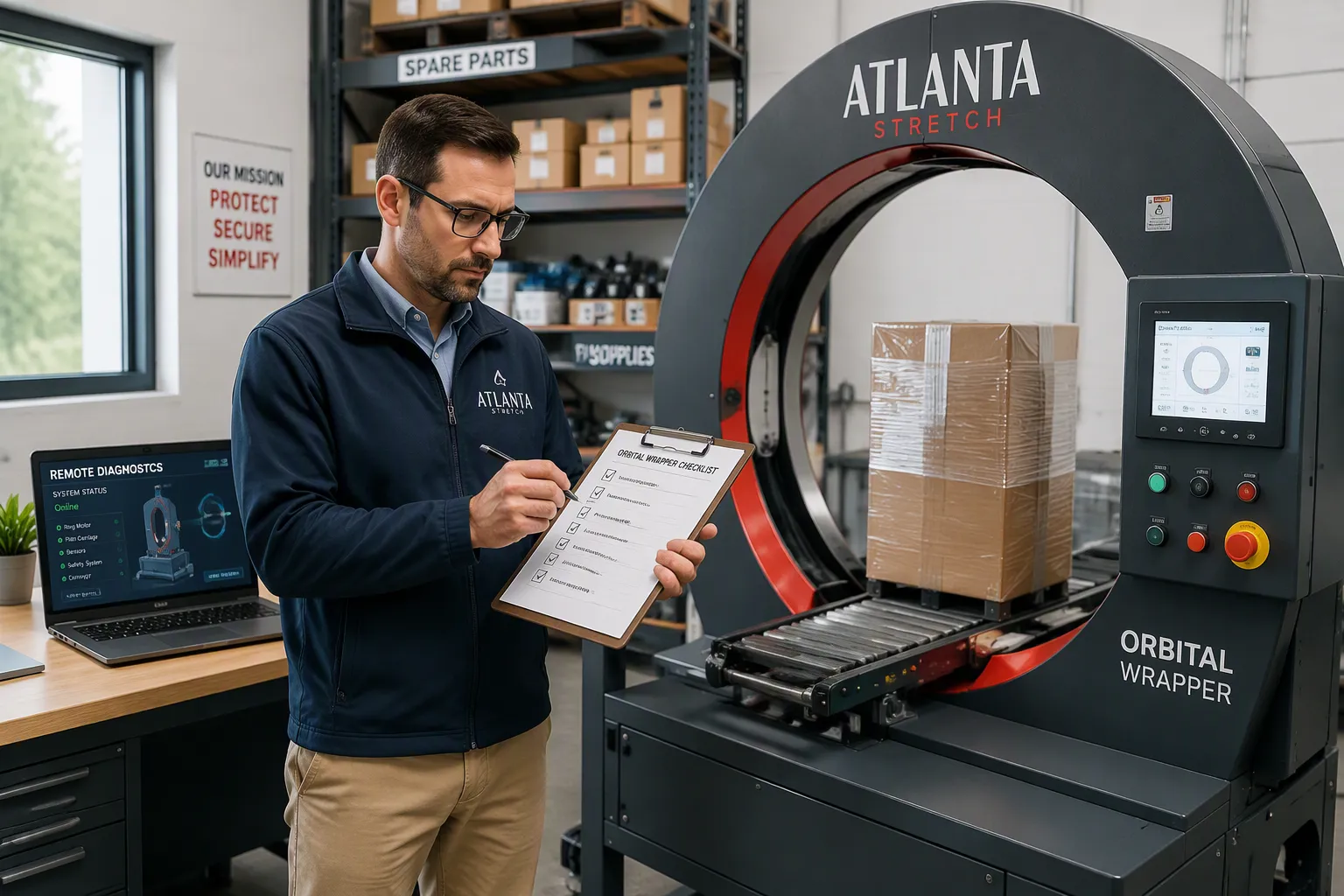
Ask each packaging machinery supplier for a two-year recommended spare-parts list. Sort the parts by how much a failure would hurt you. Figure out your yearly risk by multiplying the chance of failure by the downtime hours by the cost of each downtime hour. Make sure the maker's support includes encrypted remote diagnostics, and that you approve the connection first. Good orbital wrappers need fast parts backup, because a stopped wrapper shuts down the whole line. A hardware packing machine manufacturer should also put response times in writing.
Total Cost of Ownership
The sticker price hides the real cost. Build a TCO model across six components.
TCO Component | Description |
|---|---|
Purchase | Up-front price plus delivery, installation, setup fees, and software integration costs |
Installation | Setup and integration fees, including connection to system-wide control software; supervised installation reduces added setup costs |
Training | Training new and existing employees, plus ongoing training due to turnover and updates |
Maintenance | Ongoing upkeep, replacement parts, and preventive service |
Downtime | Operational downtime from repairs and poor reliability; wear-free components and preventive maintenance lower it |
Consumables | Supplies such as strapping materials; an ongoing expense that can surpass the purchase price over the machine's life |
Consumables need extra attention. Strapping and film costs add up on every shift. Orbital wrappers waste less film, so this cost drops over time. Orbital wrappers also cut labor needs to one or two operators. Orbital wrappers keep the wrap the same every cycle. Orbital wrappers protect edges and corners, and they add a surface barrier against moisture. For heavy furniture items, these savings add up across high-volume runs. A hardware packing machine brings its own consumables, so plan for those too. Ask hardware packing machine manufacturers for a consumables forecast. Compare hardware packing machines on total cost, not price alone. Furniture manufacturing lines with heavy output gain the most from this habit. Large furniture manufacturers should use the same approach for every unit on the floor.
Give your procurement teams a standard set of questions. Ask how the product affects equipment choice, changeover times, and material compatibility testing. Ask about OEE rating, utility requirements, and communication protocols such as Ethernet/IP and OPC-UA. Ask how long the company has built packaging machinery. Ask for case studies from the same industry. Ask about on-site response times, preventive maintenance schedules, and operator training. Ask how the company handles troubleshooting, spare parts, and upgrades. Ask for the full cost structure, including shipping and import duties. Ask how the company ensures reliability through quality control and component sourcing. Ask whether the supplier will talk about TCO instead of upfront price alone.
Red Flags to Avoid
Look out for a supplier with no furniture-specific references. General case erectors and tray formers work well in many industries, and a broad vendor can still handle a simple carton line. The problem shows up when your products are heavy sofas, wood panels, or plaster boards. Ask for installations that match your product mix. A supplier who cannot name one furniture plant reference has not tested its design against your damage risks. That gap shows up later as crushed corners and rejected loads.
Vague service promises deserve the same close look. "24/7 support" means little without a response clock, an escalation contact, and a named technician. Push for written terms. A supplier who hesitates on paper will hesitate on your factory floor at 2 a.m. The same logic applies to spare parts. Ask for a two-year recommended parts list with lead times. A vendor with no clear parts pathway leaves your line exposed, even when the machine itself is sound. Strong manufacturer support includes regional stock and documented response targets.
Compliance paperwork is another test. Request ISTA and ASTM test documents in writing. A supplier who waves off the question or promises it later has not built compliance into the design. Treat missing documents as a sign to look closer.
Finally, be wary of pressure to buy without a line audit. A site visit protects both sides. It confirms the layout, the utilities, and the product flow before anyone signs. A supplier who skips this step is selling a catalog item, not a solution.
Use these five warning signs as a quick screen:
No furniture-specific references
Vague service commitments
No spare-parts pathway
Unclear compliance documentation
Pressure to buy without a line audit
Each sign points to a supplier type with a narrower fit. A general vendor suits low-volume, standard carton work. A specialist earns the heavy-duty line. Weigh every candidate against your own product mix, and let the evidence decide. The right hardware packing machine manufacturer will welcome the audit, not avoid it. The same holds for hardware packing machine manufacturers serving other sectors. Many hardware packing machines work fine in furniture plants once the integration is proven. A hardware packing machine built for light goods may still fit a fittings line. Test the fit, then commit.
The right packaging machinery supplier for a large furniture factory shows real heavy-duty experience, automation that can grow, dependable service, and full compliance. You now have the tools to find that partner. The criteria show what to ask for. The checklist shows how to score each candidate. The red flags show when to walk away.
Use the checklist before you commit. Score every candidate on durability, integration, support, and total cost of ownership. Check furniture references and written compliance documents. Run a line audit with each finalist.
Furniture manufacturers win when they choose a long-term operational partner, not just an equipment vendor. Pick the supplier who earns that role.
FAQ
How do I check a supplier's furniture packaging experience?
Ask for a list of installations that match your products. Get contact details for two or three plants that run similar lines. Call those plants and ask about downtime, damage rates, and service response. A supplier with real experience will share these references without hesitation.
Can a general packaging vendor still serve a large plant?
Yes, for standard carton work at low volume. A general vendor fits simple case erecting and tray forming. Heavy sofas, wood panels, and plaster boards need a specialist. Match the vendor's proven range to your actual products before you sign.
Which compliance documents should I request in writing?
Ask for ISTA 2C test reports for container shipments and ISTA 2B for items over 150 lbs. Request ASTM D5276 drop tests, ASTM D642 compression data, and ASTM D6653 low-pressure results. Treat missing paperwork as a warning sign, not a formality.
How do I compare suppliers on total cost of ownership?
Build a model across six parts: purchase, installation, training, maintenance, downtime, and consumables. Strapping and film costs can pass the purchase price over the machine's life. Ask each candidate for a consumables forecast and a two-year spare-parts list.
What should a line audit cover before I commit?
A line audit confirms layout, utilities, and product flow on your floor. It checks throughput against your current and future volume. It also tests integration with your existing CNC and production lines. A supplier who resists this step is selling a catalog item, not a solution.