
 English
 Greek
 Spanish
 Ukrainian
 Turkish
 Swedish
 Portuguese
 Russian
 German
 Bulgarian
 Arabic
 O'zbekcha
 Қазақ
How to Choose a Furniture Packaging Equipment Manufacturer for Finished Cabinet Products
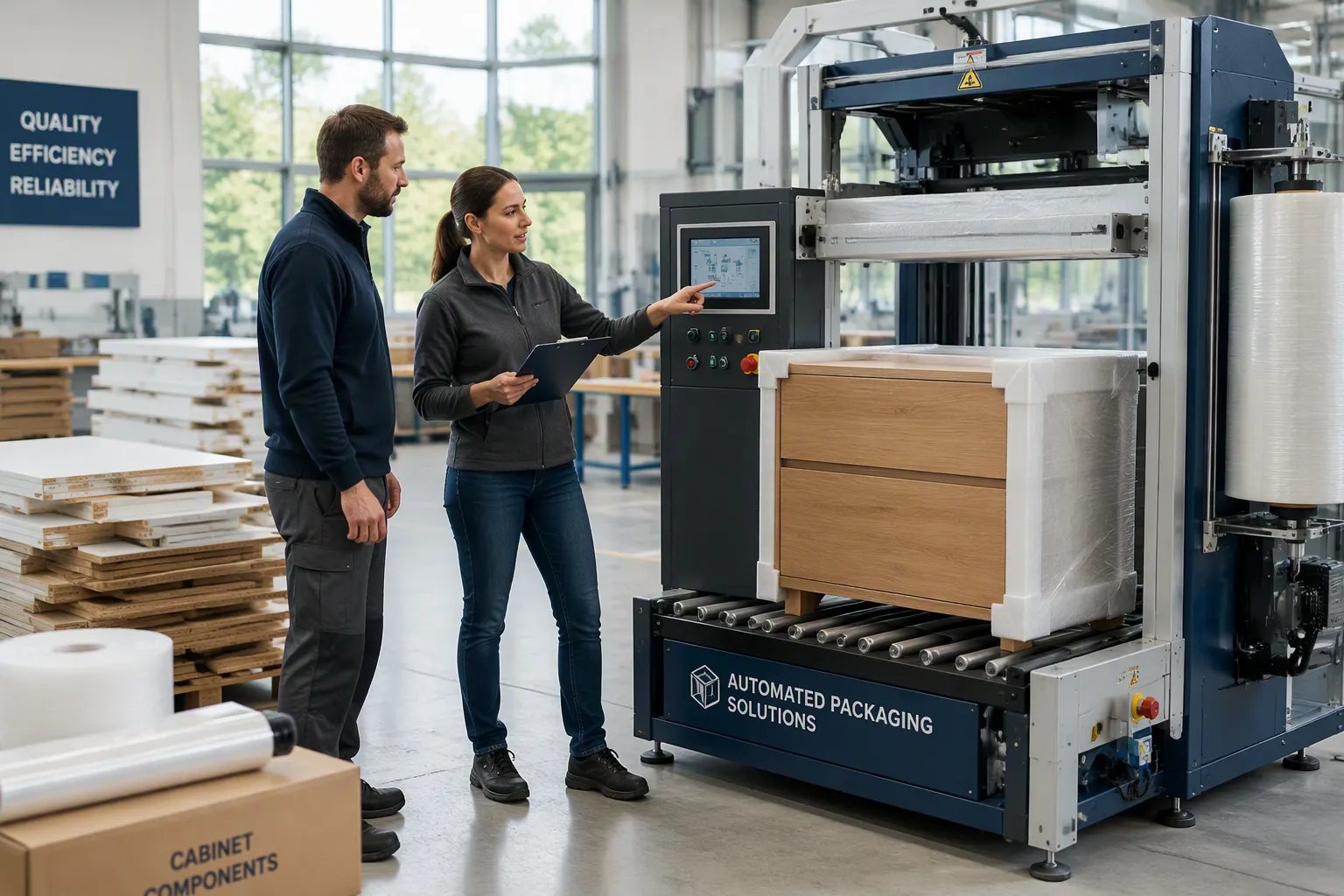
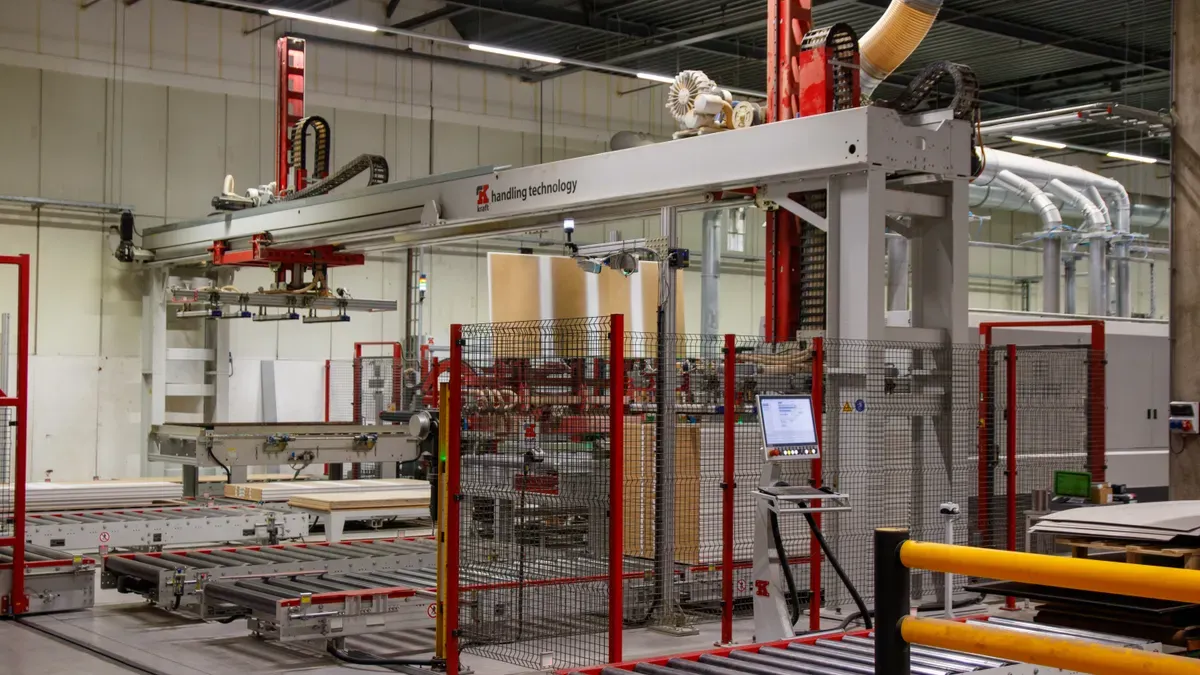
Pick a furniture packaging equipment manufacturer by checking four pillars: technical performance, application fit, regulatory compliance, and total cost of ownership. Add vendor support as a fifth lens. Finished cabinets make this structure essential. Their surfaces scratch easily, corners dent under impact, sizes vary widely, and units carry real weight through storage and transport. A low price tells you little about whether a line protects that product shift after shift. This post gives you a step-by-step framework and a decision checklist. Kitchen cabinet manufacturers can apply both right away, and you will know exactly what to ask before you commit.
Key Takeaways
Figure out your cabinet types, sizes, and damage risks first. This will help you set clear packaging requirements.
Check how well the equipment works by testing its protection quality, speed, and changeover using your own cartons.
Make sure the equipment fits your needs by checking line integration, footprint, and material handling for your cabinet mix.
Check safety certificates and shipping rules to keep workers and products safe.
Look at the total cost of ownership, including film savings and ROI, to make a smart money decision.
Define Packaging Requirements for Kitchen Cabinet Manufacturers
You can't compare vendors until you know exactly what your line must protect. Start by making a full list of your cabinet types, sizes, and how easily their finishes can be harmed. Write down every door style, panel size, and surface treatment you make. This list becomes the baseline for every talk with a vendor.
Map Cabinet Types and Damage Risks
Finished cabinets face different threats at each stage. Corner and edge impact damage is the most common problem during shipping and handling. Dents, chipped corners, cracks, and compression marks all show up here. Door and drawer fronts get scratches, dents, and surface defects. Crushed boxes, torn packaging, and water stains are signs of possible shipping damage. Finish-related defects include color differences, bubbling, and visible scuffs.
Damage Category | Specific Types of Damage Observed |
|---|---|
Corner and edge impact damage | Dents, chipped corners, cracks, compression marks |
Door and drawer front surface damage | Scratches, dents, surface defects, edge damage |
Packaging condition indicators | Crushed boxes, torn packaging, water exposure or moisture stains |
Finish-related defects | Color inconsistencies, uneven finish, bubbling or blistering, visible scratches or scuffs |
Write down which risks apply to your product mix. A custom cabinet manufacturer with high-gloss finishes faces different exposure than a shop building painted MDF. Your packing method must address the full finished product, including cabinet materials and hardware.
Set Throughput and Line Constraints
Set your throughput targets before you contact any vendor. Measure units per hour, line speed, and available floor space. Note how often you switch between cabinet models. Changeover time matters a lot for kitchen cabinet manufacturers with diverse product lines.
Footprint limits often decide which equipment fits your plant. Measure your actual floor space and account for operator access. Record your electrical and pneumatic service capacity. These limits narrow the field quickly.
Your requirements must also cover export packing scenarios. International shipments add handling stages and climate exposure. Kitchen cabinet manufacturers who ship overseas need packaging that survives longer transit. State these needs upfront. Clear requirements give every vendor the same target and protect your quality standards from the start.
Evaluate Technical Performance and Quality
Technical performance shows whether a vendor really delivers or just talks well. Compare every candidate on protection, speed, reliability, and changeover.
Protection Quality and Consistency
Good protection starts with packaging that is the right size for furniture and cabinets. Ask how the machine controls wrap tension. Loose wrap lets panels shift, while too much tension crushes corners. Confirm the corner protection plan and the surface protection for finished faces. Then check consistency across shifts. Manual packing varies with how much attention the operator gives. Automated and semi-automated end-of-line packaging equipment give you application consistency, so products are packaged correctly and protected. Case sealers and erectors prevent misaligned flaps and weak seals, while stretch wrappers reach optimal containment force to prevent load failures. Automation gives you standardization across multiple shifts and a standard level of quality control that manual processes cannot match.
Measure quality consistency with a defined method. Set the scope by product family, packaging configuration, facility, and review period. Define the measures, including units, calculation methods, data sources, and owners. Capture the baseline before any change. Update and validate records for the agreed period. Review results against the baseline and document your decision. Consistent definitions make comparisons credible. Segment results by product family or shipment type where differences could affect performance. Add a quality inspection step at the end of each shift to confirm wrap tension, corner fit, and seal integrity. This step turns repeatable quality into a measurable target.
Compare technical criteria across vendors using one table.
Technical criterion | Why it matters when comparing equipment |
|---|---|
Finished pack dimensions (incl. corner protectors & cushioning) | Modules must be verified against the actual pack range, not nominal sizes |
Height & weight distribution | Flat panel packs vs. assembled cabinets differ; do not assume one configuration fits both |
Supporting surface / base support | Determines structural support the outer pack must provide |
Protection needs (vulnerable corners, edges, finishes) | Defines cushioning and surface-protection roles |
Module verification against real pack range | Each selected module must be checked against representative samples |
Manual vs. automatic task split | Identify which stages are operator-driven vs. machine-included |
Carton preparation, folding, closing, conveying | Cutting, folding and closing stages must be checked together as one flow |
Mixed-size / changeover capability | An adjustable machine does not prove continuous mixed-size operation |
Sample testing & acceptance scope | Compare the same carton samples and acceptance scope for a fair quotation |
Also compare filling system type, pneumatic versus servo drive systems, build materials, control and programming capabilities, and supported package formats. A one-stop portfolio covering fasteners, fastening tools, and industrial packaging can streamline procurement. Specialist vendors may fit narrower needs better. Weigh both options neutrally against your requirements.
Speed, Reliability, and Changeover
Speed claims need proof. Ask for demonstrated throughput on samples that match your real pack range. Check reliability data and mean time between stops. Changeover time matters most for kitchen cabinet manufacturers with mixed product lines. An adjustable machine does not prove continuous mixed-size operation or automatic MES interface. Request a trial on representative samples. Kitchen cabinet manufacturers should also confirm the manual versus automatic task split for loading, protective-material placement, folding, closing, and discharge. Kitchen cabinet manufacturers who run many sizes need fast, repeatable changeovers. Verify the packing method on your own cartons before you sign.
Confirm Application Fit and Cabinet Materials
Line Integration and Footprint
A machine that works well in a showroom can still fail on your floor. Check how the unit fits your existing line before you compare prices. Plan operator walkways at a minimum of 1.0 m on the main operating side and 0.6 m on the non-operating side. Leave 0.8 m behind electrical cabinets and control panels so doors open fully. Film rolls weigh 20–40 kg, so reserve at least 1.5 m behind the unwind station for loading. If you move pallets by forklift, keep a clear aisle of 2.5–3.0 m.
Planning Area | Recommended Specification |
|---|---|
Operator walkway | Min. 1.0 m main side; 0.6 m non-operating side |
Maintenance access | 0.8 m behind electrical cabinets |
Film roll loading zone | Min. 1.5 m behind unwind station |
Forklift/pallet aisle | 2.5–3.0 m clear aisle |
Check that your power and air supply meet what the machine needs. Smaller units run on 220V single-phase at 1.5–4.0 kW. Larger machines may need 380V three-phase with dedicated circuits. Compressed air usually runs at 0.5–0.6 MPa and 4–5 L/min per machine, with a dryer and filter within 5 m. Decide early how faults will be handled. Ask how the line responds when a machine stops, a product is missing, or a downstream process is unavailable. This planning protects cabinet quality once production starts.
Cabinet Materials and Size Range
Your cabinet materials decide the protection strategy. Solid wood, plywood, MDF, and particleboard react differently to moisture, impact, and wrap tension. A custom cabinet manufacturer with mixed substrates needs a machine that handles each one without crushing edges or trapping moisture. Share your production drawings with the vendor. These drawings show panel thickness, hardware cutouts, and corner geometry that affect packing.
Size range decides machine flexibility. List your smallest and largest cabinet boxes, including assembled units and flat packs. Confirm the machine covers that full range, not just nominal sizes. Kitchen cabinet manufacturers who run many SKUs should test changeover on representative samples. Ask whether the system supports future SKU growth and production expansion. Kitchen cabinet manufacturers with diverse lines need this assurance. Cabinet box construction also matters. Reinforced corners and heavy hardware add weight and shift the center of gravity. Verify the machine handles that load. Kitchen cabinet manufacturers who confirm these details upfront avoid costly retrofits later.
Verify Regulatory and Safety Compliance
Equipment Safety and Certifications
Safety compliance keeps your workers and your finished product safe. Ask each vendor which safety standards the machine meets, and get the certificates in writing. Make sure guards cover all moving parts, pinch points, and the wrap or seal mechanism. Look for emergency stops at every operator station. Also check for interlocked access doors that stop the machine when opened. Confirm the electrical panel rating and the lockout procedure for maintenance.
A serious vendor documents these points and welcomes an on-site safety review. Ask how the control system handles a fault during a cycle. Confirm that the machine fails safe instead of releasing tension or dropping a load. Add this review to your quality control plan. That way, every unit passes a defined inspection before it leaves the line.
Shipping and Sustainability Standards
Your compliance checks must go beyond the machine to export packaging. Wood packaging material falls under ISPM-15, and the rule applies even when the cabinet itself is boxed. The pallet or skid needs a visible IPPC stamp on the outside. Destination rules differ, so confirm them before you book freight.
Destination | Wood Packaging / Treatment Rule |
|---|---|
United States | ISPM-15 compliance is mandatory; some states require a wood species declaration in certain cases |
European Union | ISPM-15 required; EU timber regulations apply to raw wood imports (chain-of-custody requirement) |
Middle East | ISPM-15 mandatory; extra fumigation checks for untreated wood |
Sustainability certifications strengthen your market position. The KCMA ESP seal shows environmentally responsible cabinet production, and wood certifications trace fiber back to responsible sources. Ask vendors how their export packing materials match those claims. General guidance for crate design and marking appears in ASTM D 3951-95 and Title 49 CFR. A base should extend 2"–3" beyond the widest item on each side. Units shipped without a base need at least 6" of dunnage. Reliable shipping support from your vendor keeps these details on track.
Analyze Total Cost of Ownership
Purchase price is only the first number. You must weigh every cost the machine creates across its working life.
Operating and Consumable Costs
Film is your biggest long-term cost. Film use makes up 60–70% of total wrapping costs over the machine's life. Power pre-stretch changes that math. It stretches film 200–250% and cuts material use by up to 50%. Film savings alone reach 30–50%. Also factor in maintenance contracts and parts availability. Model them before you sign. High-volume kitchen cabinet manufacturers feel film costs most.
Cost Factor | Detail |
|---|---|
Film share of total wrapping costs | 60–70% over machine lifespan |
Material reduction via power pre-stretch (200–250%) | Up to 50% |
Film savings from power pre-stretch | 30–50% |
Other long-term costs | Film usage, maintenance contracts, parts availability |
ROI and Financing Options
Build your business case in five steps. First, add up the ownership cost: purchase price, freight, commissioning, training, and yearly maintenance and parts. Second, figure net benefit in three areas: yearly labor costs, yearly gross profit, and business-specific expenses. Third, add up the net gains or losses. Fourth, use the simple ROI formula: (net benefit / total new equipment cost) x 100. A $150,000 benefit on a $200,000 machine gives 75%. Fifth, work out payback period: total cost / periodic benefit. That same example pays back in 1.3 years. Labor savings alone often bring ROI in 18–24 months, and wrapping time drops from 5–10 minutes per load to 1–2 minutes.
Financing gives you more choices. Vendor financing runs 5%–12% with terms of 24–84+ months. Operating leases run 6%–20% over 24–60 months. Capital leases last 36–84 months and end in ownership. Traditional bank loans run 6%–15% with 10%–20% down. SBA 7(a) loans reach up to $5M over 10 years. Ask each vendor about production lead time and delivery time, because slow installation delays your payback clock. Strong support during commissioning protects your quality targets, and routine quality checks keep the line honest. Ask about support terms in writing. Clear export packaging terms avoid surprise freight costs. Confirm export packing details early, and verify the packing method on your own cartons. Kitchen cabinet manufacturers should also ask for references from similar operations before committing.
Evaluate Furniture Packaging Equipment Manufacturer Support
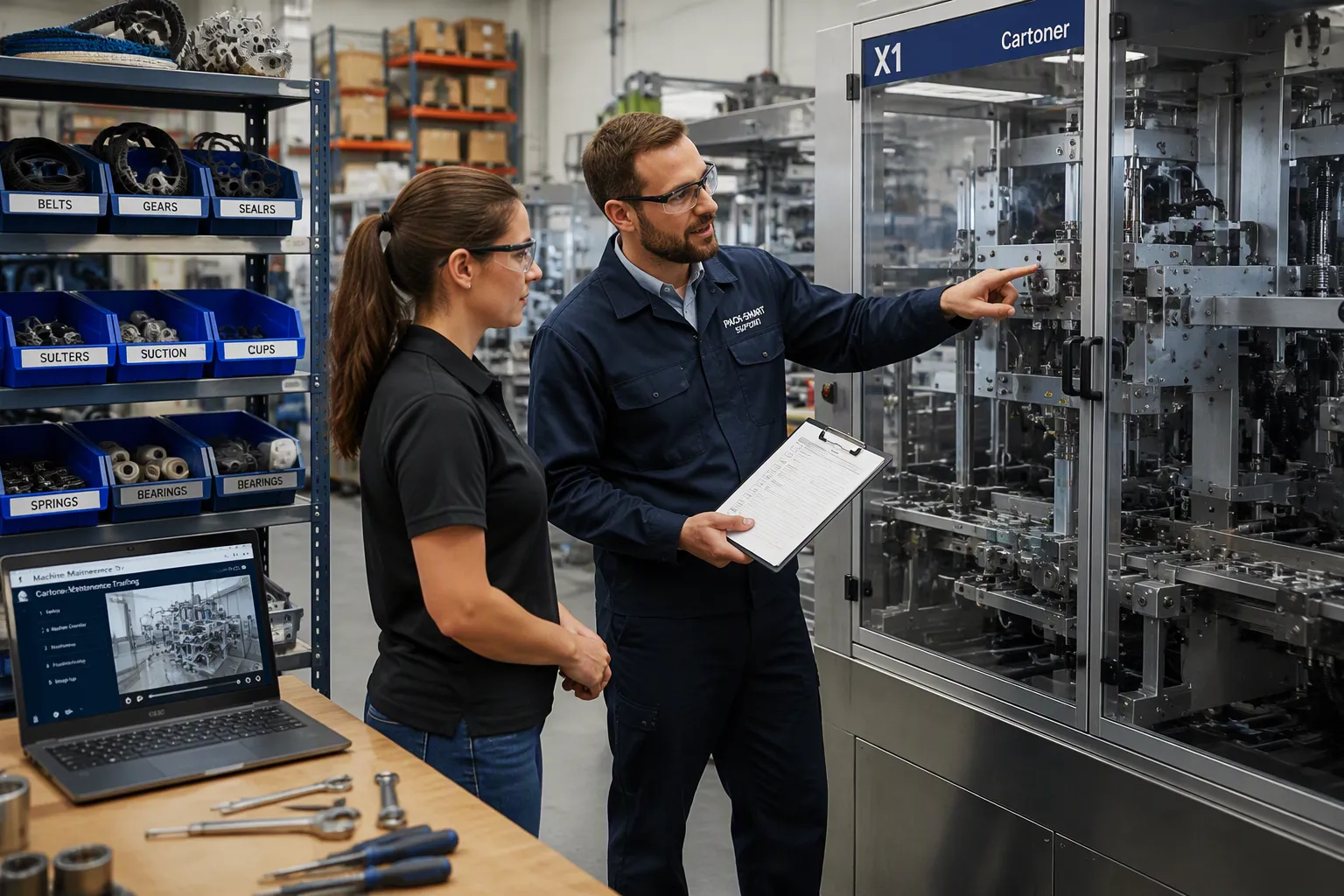
A machine is only as good as the help behind it. Judge support as carefully as you judged technical performance. Ask each furniture packaging equipment manufacturer to put its after-sales service structure in writing. Confirm who answers your call, how fast a technician arrives, and what happens when a part fails mid-shift.
Service, Spare Parts, and Training
Spare parts availability decides how long a line stays down. EDL Packaging states that it strives to keep relevant spare parts in stock for immediate shipment and will work with customers to fulfill their packaging equipment spare parts requirements. Ask for the same promise in your contract. A strong parts program covers several areas:
Replacement parts availability for form-fill-seal, flow-wrap, cartoners, case packers, labelers, conveyors, sealers, and more
Repair support and failure analysis to reduce repeat breakdowns
Reverse engineering to produce exact-fit replacements for discontinued OEM parts
Typical shipping turnaround of 3–5 business days, with rush service available
Over 2,500 distinct parts in stock, plus tooling repairs, on-site repair, reconditioning, and machine setup/installation services
Training turns operators into problem solvers. General manufacturing efficiency guidance names training and retraining as a key factor: employees should be recently trained and updated in best practices for machine operation, maintenance, and safety. Randy Thompson, head of PCA's Packaging Performance Group, makes the case plainly:
Every hour spent in training gets paid back exponentially in uptime of your process down the line.
Structure the program well. Studies show that training taught in a systematic way has the strongest effect on what manufacturing workers learn. It should highlight how ideas connect and start with big-picture information before moving to smaller, specific rules. Train operators on the equipment's different systems and how they work together first, then dive into individual modules, components, and parts. Once operators are up to speed, the line's flow rate should quickly follow suit. Kitchen cabinet manufacturers with mixed SKUs benefit most from this layered approach.
Track Record and References
Ask for reference sites where you can watch the full production line run in real time. A live visit proves actual performance before you commit. Check the manufacturer's reputation and reliability within the industry. Look for a proven track record of delivering high-quality products and strong customer service. Read customer reviews to judge past performance. Ask for references from previous clients. Evaluate experience, certifications, awards, and testimonials from satisfied customers.
Weigh production capacity against your growth plans. A custom cabinet manufacturer with seasonal peaks needs a vendor that scales with demand. Ask how the vendor handles shipping support for export orders and how its customer service team responds to urgent requests. Deep manufacturing experience shows in how calmly a vendor handles your toughest questions. A furniture packaging equipment manufacturer with a long reference list and open factory doors earns trust faster than one with polished brochures. Kitchen cabinet manufacturers should also confirm that quality records from reference sites match their own standards. Support you can verify beats support you must imagine.
Build a Decision Checklist
Score Vendors Against Your Criteria
Decide how much each criterion matters before you look at any names or prices. Treat required conditions as pass/fail gates. Never average them away. Send the same specification and question set to every candidate. That way, price differences show real competitiveness, not different assumptions. A furniture packaging equipment manufacturer that sends back a full compliance matrix earns trust faster.
Criterion | What to score |
|---|---|
Technical compliance | Compliance matrix (comply / deviation / not offered) against each specification line, with evidence referenced |
Evidence strength | Catalog values for low-risk screening; third-party reports and lot-linked certificates for safety-critical items |
Process control | Incoming inspection, parameter control, in-process checks, final inspection, calibration, nonconformance handling |
Change management | How revisions, deviations, and substitutions are controlled and communicated |
Capacity fit | Whether supplier capacity matches your demand volumes and variability |
Logistics | Delivery coordination, replenishment, and inventory visibility |
Service response | Responsiveness and operational support arrangements |
Commercial terms | Milestones tied to drawings, sample acceptance, inspection, documentation, shipment, and site acceptance |
Build a lifecycle model that goes beyond the purchase price. Include qualification, installation, utilities, consumables, planned maintenance, calibration, spares, training, expected downtime, yield loss, disposal, and change-control work. Use ranges when inputs are uncertain. Show which assumptions drive the result. Set up scenarios for normal operation, likely deviation, and severe failure. Estimate consequence and recovery time without pretending uncertain values are precise. The goal is to expose sensitivity, not to invent an impressive total.
Use one rating method the same way every time. Avoid points that suggest more certainty than the evidence supports. Record the operational consequence and evidence strength for each finding. Keep the rationale next to the rating. Set audit cadence by risk and change, and revisit it after product changes or delivery disruptions.
Questions to Ask Before Signing
Ask what costs go beyond the quoted contract price. Confirm how change orders are handled and what triggers extra labor or material charges. Check whether commissioning, training, and service costs are included or billed hourly plus technician travel. Ask about late payment fees. Confirm whether standard machine checkout is included and whether Factory Acceptance Testing or Site Acceptance Testing costs extra. List other fees left out of the quote, such as taxes, expedited shipping, customs, storage, tariffs, and inspections.
Pin down production lead time and delivery time in writing. Ask how the vendor handles quality inspection details at the factory and who signs off. A custom cabinet manufacturer should request sample acceptance criteria. Kitchen cabinet manufacturers need clear packing specifications for export orders. Confirm the customer service contact and escalation path. Ask how support covers spare parts and training after handover. Kitchen cabinet manufacturers who lock these answers into the contract protect both quality and budget.
You now have a repeatable sequence. Define requirements first. Then compare vendors on technical performance, application fit, compliance, and total cost of ownership. Finish with a support evaluation. Treat those four pillars as a durable framework for future purchases.
Apply the decision checklist before you commit. Request a demonstration on your own cartons and quality references from similar operations. A furniture packaging equipment manufacturer earns your order through evidence.
Kitchen cabinet manufacturers should weigh quality records and support terms equally. The best fit matches your cabinet mix, line, and budget. It is not always the cheapest or largest option. Kitchen cabinet manufacturers who score vendors honestly choose well.
FAQ
How long should a vendor evaluation take?
Set your requirements first, then score every candidate against the same checklist. A focused evaluation moves faster than an open-ended search. Ask for sample runs and references early. You can compare vendors on technical performance, application fit, compliance, and total cost of ownership within a few weeks.
What single factor most often decides the choice?
Application fit decides more outcomes than price. A machine must match your cabinet sizes, materials, and changeover needs. Check how it performs on your own cartons. A perfect machine on paper still fails if it cannot handle your real pack range.
Do I need a factory visit before signing?
Yes. Ask to watch a full line run in real time at a reference site. A live visit proves actual performance. Kitchen cabinet manufacturers should also make sure that quality records from those sites match their own standards.
How do I compare quotes fairly?
Send the same specification and question set to every vendor. Require a compliance matrix with evidence for each line. Then build a lifecycle cost model that includes film, maintenance, spares, and training. Price differences then show real competitiveness, not different assumptions.
What belongs in the contract beyond price?
Pin down lead time, delivery time, commissioning, training, and service terms in writing. Confirm spare parts availability and the escalation path. Add sample acceptance criteria and export packing specifications. Clear terms protect both your quality targets and your budget.